6. Vector model
This section describes the VECTRI (VECtor-borne disease community model of ICTP, TRIeste) model, a dynamical, high-resolution model of mosquito lifecycles that is coupled to a simple SEIR model for malaria in the human population. The model is designed to simulate the impact of climate variability and change on malaria epidemiology. VECTRI accounts for the coupled dynamics of the mosquito vector and human host, incorporating key environmental drivers such as temperature and precipitation, as well as human population density and interventions. The model aims to provide a robust tool for malaria early warning systems, climate change impact assessments, and general research into vector-borne disease dynamics. A comprehensive introduction to the model’s core structure and initial evaluation can be found in [TE13].
6.1. Typical Climate Sensitivities of VBD
Vector-borne diseases (VBDs), particularly malaria, exhibit significant sensitivity to climatic factors. Understanding these sensitivities is crucial for accurate modeling and prediction.
- Temperature $(T)$: Temperature is a primary driver influencing various aspects of both the mosquito vector and the malaria parasite’s life cycles [TE13].
Mosquito Development: Higher temperatures generally accelerate larval development, pupation, and adult emergence, up to an optimal range. Beyond this optimum, extreme heat can increase mortality.
Adult Longevity: Mosquito longevity is inversely related to temperature; warmer conditions typically reduce adult lifespan. This is critical as only older, parous mosquitoes are likely to have bitten an infected human and subsequently developed infectious sporozoites.
Parasite Development (Extrinsic Incubation Period - EIP): The development of the Plasmodium parasite within the mosquito vector (the EIP) is highly temperature-dependent. Warmer temperatures drastically shorten the EIP, leading to faster transmission cycles. This relationship is often non-linear, with an optimal temperature range for parasite development.
- Rainfall ($R$): Precipitation directly impacts the availability of breeding sites for mosquito larvae.
Breeding Site Creation: Rainfall creates temporary pools and maintains permanent water bodies, providing essential habitats for oviposition and larval development. Vectors such as An. gambiae rely heavily on ephemeral, rain-fed pools, while vectors such as An. stephensi and Aedes albopictus are well adapted to urban environments and have direct of a direct link to rainfall,
Flushing Effects: Excessive or intense rainfall can have a detrimental effect on larval populations by flushing out larvae from breeding sites or destroying them.
Humidity: While not always directly modeled as a standalone variable, high humidity often accompanies rainfall and can influence adult mosquito survival.
Relative Humidity $(RH)$: RH primarily affects adult mosquito survival. Low humidity can lead to desiccation and increased mortality rates for adult mosquitoes. While sometimes implicitly linked to rainfall, its direct impact on adult survival is also important.
Wind $(U)$: Wind can influence mosquito dispersal and host-seeking behavior, though its explicit representation in large-scale malaria models is often simplified or implicitly accounted for. Strong winds can hinder flight and reduce biting rates.
These sensitivities are understood from a combination of laboratory studies (e.g., controlled experiments on development rates) and field observations. However, significant uncertainties remain due to the complex interplay of these factors, local environmental heterogeneity, and confounding socio-economic and intervention factors. The motivation for VECTRI is to integrate these climate sensitivities within a dynamical framework, accounting for their non-linear impacts and spatial variability, to provide a more robust representation of malaria transmission dynamics [TE13].
6.2. VECTRI Structure
VECTRI simulates the coupled dynamics of mosquitos with specific parameterizations for several Anopheles and Aedes species, and also represents the human host population. The model resolves the life cycles of mosquitoes, driven by meteorological forcing data (temperature and precipitation). The core structure involves:
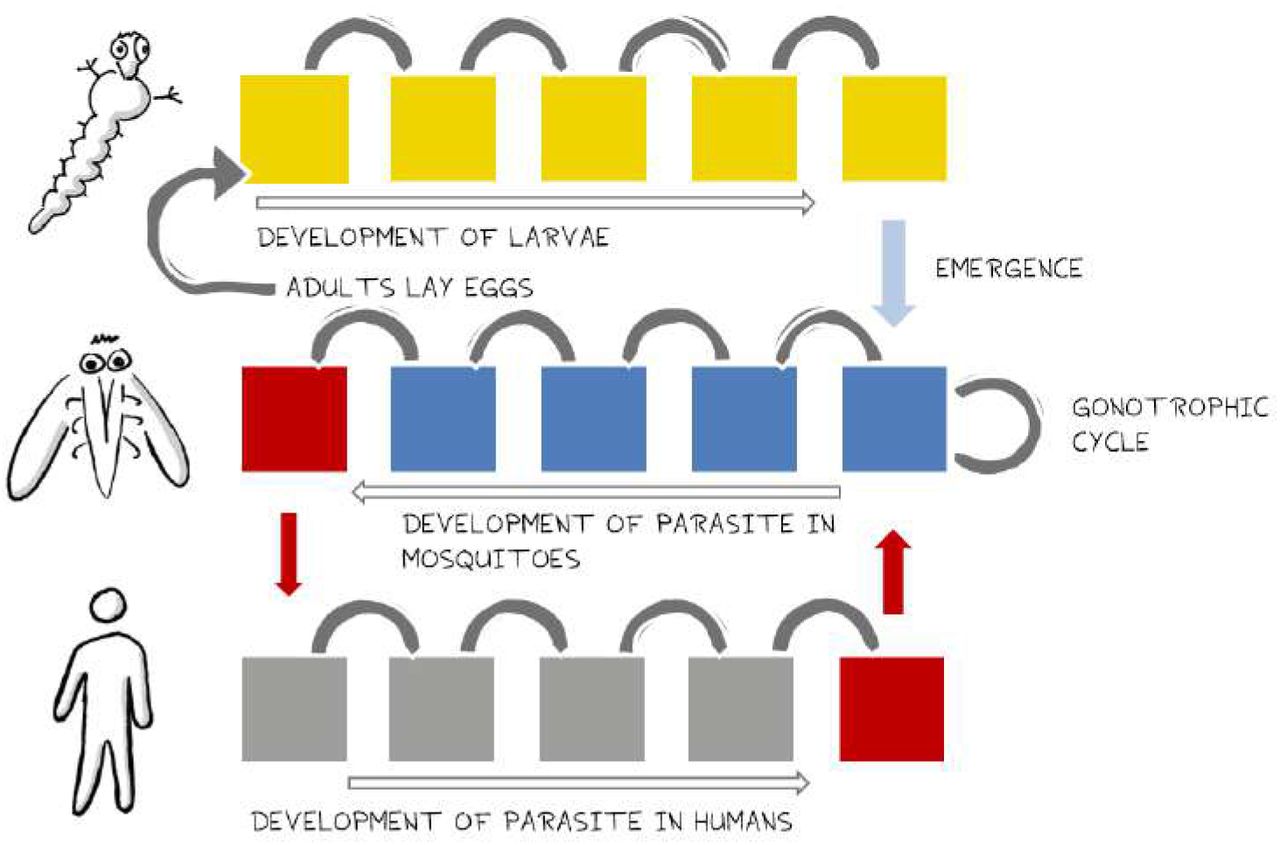
Vectri structure when coupled to the malaria model (From Martin-Makowka et. 26, submitted)
Larval Cycle: Modeling the aquatic stages of the mosquito, from egg hatching, through larval instars, to pupation and emergence. This component is highly dependent on water availability (driven by rainfall) and temperature.
Adult Cycle: Tracking the adult mosquito population, including emergence, mortality, and key epidemiological processes such as biting, infection, and development of the malaria parasite within the Anopheles mosquitoes.
Human Population: Representing the human host population. At the moment the model only includes a parameterization for malaria, with homeans divided between susceptible, exposed, infected, and immune recovered categories. There is a beta release version of a code with an agent based representation of the human population, which will eventually include modules for other diseases such as dengue. The impact of interventions is also included such as bednets and SIT.
The model operates on a daily timestep, allowing for the capture of rapid changes in environmental conditions and their immediate effects on mosquito and parasite development [TE13]. It uses a box model approach where each geographical grid cell is treated as a separate, interconnected system.
6.3. Larvae Cycle
The larvae cycle in VECTRI simulates the aquatic stages of the mosquito’s life. The model resolves larvae biomass ($L$) in a series of “boxes” or compartments, representing different developmental stages or aggregated biomass. Note that at the moment these are equal fractional compartments that do not map directly onto larvae instar.
`The general rate of change of larvae biomass in a given box is governed by:
Source of Eggs: Gravid female mosquitoes lay eggs, providing a source for the larval population. This input is dependent on the adult female mosquito population and their oviposition rates.
Growth Rate: Larvae grow through several instars. The growth rate is highly sensitive to ambient temperature and resource availability, and is represented as a degree-day process.
Emergence: Larvae successfully developing through their aquatic stages emerge as adult mosquitoes. This is the primary source for the adult population.
Mortality: Larval mortality can arise from various factors:
Resource Limitation: Competition for food resources within breeding sites can lead to density-dependent mortality. L4 larvae can also cannibalize L1 instar when resources are scarce but this is currently not parametrized in the model.
Heat Stress: Extreme high temperatures can be lethal to larvae.
Underlying Mortality: Background mortality due to predation, disease, or other environmental factors.
Flushing: Intense rainfall events can flush larvae out of breeding sites, contributing to mortality.
The rate of change of larval number in the $i_{th}$ compartment, \(\frac{dL_i}{dt}\), can be expressed as:
- where:
$V$ is the female vector density
$G(T)$ is the fractional, temperature-dependent gonotrophic cycle rate
$N_{egg}$ neggmn is the number of female eggs per oviposition event.
$F(T_w)$ is the temperature-dependent growth rate of larvae to the next stage or to emergence.
\(\gamma(T_w,R)\) is the temperature and rainfall dependent mortality rate.
$T_w$ is the water temperature
$T$ is the two meter air temperature
$R$ is the rain rate
The surface hydrology component, crucial for determining the availability and persistence of breeding sites, is driven by precipitation. Tompkins and Ermert (2013) utilize a simple, physically based representation of surface hydrology. The rate of change of fractional pond coverage ($w_{pond}$) is given by:
- where:
$K_w$ is a parameter related to the aggregate pond geometry.
$P$ is the precipitation rate.
$w_{max}$ represents the maximum fractional coverage for ponds (related to overflow losses).
$E$ is the evaporation rate.
$I$ is the infiltration rate.
This equation describes how ponds fill with precipitation and are depleted by evaporation and infiltration, thereby controlling the available habitat for larval development [TE13].
6.4. Adult Cycle
The adult mosquito population dynamics ($A$) in VECTRI are fundamentally driven by the emergence of new adults from the aquatic larval stages and the mortality of existing adults. The basic equation for the rate of change of the adult mosquito population is:
- where:
$E_A$ is the emergence rate of adult mosquitoes from the larval stage. This term directly links the larvae cycle to the adult population.
$M_A(T)$ is the temperature-dependent mortality rate of adult mosquitoes. As mentioned, warmer temperatures generally lead to higher adult mortality, reducing their lifespan.
$M_I$ is an additional mortality rate term, which can be augmented by interventions such as indoor residual spraying (IRS) or insecticide-treated bed nets (ITNs).
The temperature dependency of adult mortality is a critical factor influencing the entomological inoculation rate (EIR) and overall transmission intensity, as it determines the proportion of mosquitoes that survive long enough to become infectious after acquiring Plasmodium parasites from an infected human.